
The Mechanical Sublime: Shin Takamatsu’s Ark and its Cyberpunk Vision of Kyoto
If Kengo Kuma’s M2 Building represents the hallucinatory, fragmented dreamscape of the Japanese bubble era, Shin Takamatsu’s Ark (1983) is its dark, heavy, mechanical heartbeat. Years before Tokyo’s stock market reached its dizzying peak, Takamatsu was already forging a breathtakingly intense, menacingly beautiful architectural language in Kyoto—one that felt less like traditional building and more like high-tech sorcery.
While Kyoto is globally celebrated for its quiet temples and wooden machiya townhouses, Takamatsu chose to inject the ancient city with a dose of pure, undiluted industrial futurism.

Commissioned, almost extraordinarily, to house a local dental clinic, Takamatsu took a mundane medical brief and transformed it into a monumental, windowless fortress of polished concrete, glass, and gleaming metal. Rather than looking outward to the street, the building closes itself off, turning inward like a secretive, high-tech laboratory.
The design is a brilliant, aggressive exercise in architectural anthropomorphism. It does not resemble a place of healing; instead, it looks like a massive locomotive engine, a futuristic dreadnought, or a complex piece of heavy industrial machinery dropped directly into the quiet, traditional fabric of its neighbourhood.

With its row of ten giant, rhythmic skylights mimicking mechanical cylinders, the Ark does not sit quietly in its environment. It hums with an ominous, silent energy, appearing as though it might at any moment detach itself from the foundations and rumble down the Kyoto streets. Every rivet, seam, and metallic joint is rendered with absolute precision and obsession. It is an architecture of sublime, dystopian power-a physical manifestation of the cyberpunk aesthetic before the genre even had a name.
In the decades since its construction, the Ark has remained a legendary pilgrimage site for anyone fascinated by the moments when architecture completely broke free from standard functional constraints to become something purely, magnificently theatrical. It stands as a monument to a unique cultural moment when the boundaries between science fiction and the built environment dissolved entirely.
Capturing the Miniature Machine

The uncompromising, industrial intensity of the Ark is precisely what makes it such a compelling icon to bring to life. It represents an era when Japanese architects possessed the supreme audacity and the financial backing to build the impossible, turning avant-garde theories into permanent concrete and steel realities.
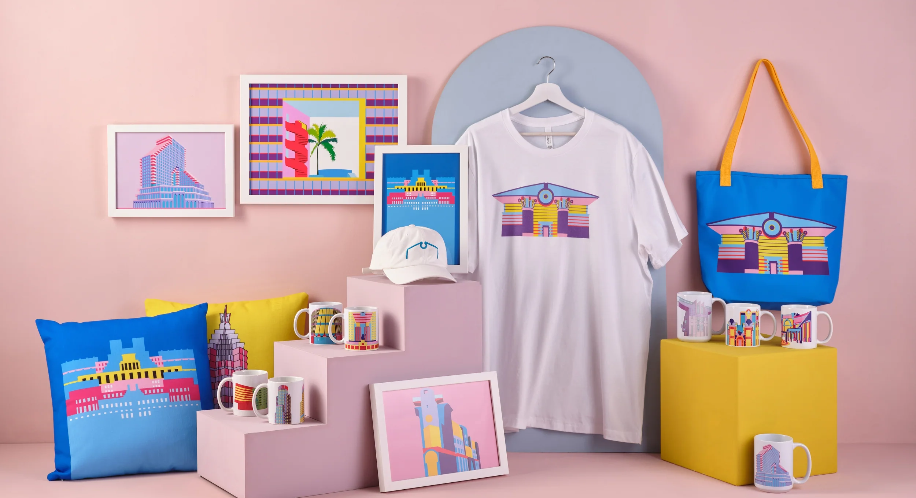
To celebrate this radical monument, we have captured its soaring cylindrical skylights, deep-set grooves, and fortress-like presence in our new Ark Collection. Crafted to preserve the intense, tectonic drama of Takamatsu's vision, it allows you to hold the sublime power of this architectural machine right in your hands.

The Ark is just one spectacular chapter in a much wider, equally daring narrative of twentieth-century Japanese design. From the utopian, biological structuralism of the Metabolists to the wild, expressive forms of the bubble era, the country's urban landscape remains an endless source of inspiration. If you wish to explore further, you can discover our full curation of tributes via our complete Japan Buildings Collection, or our Shin Takamatsu collection.