
Owen Luder’s Trinity Square Car Park: The Lost Cathedral of Concrete
Some buildings do not merely occupy a space; they crash into the consciousness of a city like a thunderstorm. Standing as an absolute titan of British Brutalism, Owen Luder’s Trinity Square Car Park in Gateshead was a raw, muscular, and terrifyingly sublime statement of twentieth-century ambition. Though tragically demolished in 2010, this colossal concrete monument lives on in the cultural memory as a masterclass in sci-fi intensity, cinematic grit, and uncompromising architectural theatre.
 Completed in 1967, the multi-storey structure was designed by the legendary partnership of Owen Luder and Rodney Gordon with Ron Worthington as project architect. They did not see a car park as a mundane utility block, but as a soaring monument to the machine age.
Trinity Square was a composition of pure kinetic energy frozen in board-marked concrete. Its design was defined by raw, exposed columns, dramatic cantilevered decks, and twin external lift towers that sliced into the Tyneside sky like launching pads for an alien spacecraft.
The crowning glory of this structural masterpiece was its legendary rooftop restaurant. Perched high above the parking decks on delicate concrete pillars, this glazed box was designed to offer panoramic views across the River Tyne. It was a thrilling, futuristic vision of dining in the clouds, yet due to commercial disputes, it never officially opened its doors. Instead, it sat empty for decades - a magnificent, ghostly capsule suspended between earth and sky, embodying a lost future that never quite arrived.
It was this precise quality of atmospheric, industrial menace that caught the eye of director Mike Hodges. In 1971, the car park was cast in a starring role alongside Michael Caine in the seminal British gangster film Get Carter. The building became the ultimate visual shorthand for the film's gritty, uncompromising narrative. The scene where Caine's character flings a corrupt businessman from the upper decks forever cemented Trinity Square into the annals of British cinematic history, earning it the permanent moniker of the "Get Carter Car Park."
 "In its raw, unpainted simplicity, concrete is the most beautiful material in the world." - Owen Luder
Over the years, the building split public opinion down the middle. To some, it was an oppressive, grey behemoth; to others, it was a thrilling work of pure architectural poetry, a structure that refused to be polite or boring. Its demolition in 2010 was a profound loss to Britain's post-war heritage, transforming the building from a physical entity into an almost mythic legend of vanished modernism.
Wearing the Legend of the Get Carter Car Park

Though the physical walls of Trinity Square have been reduced to dust, its radical, sculptural silhouette remains completely unforgettable.
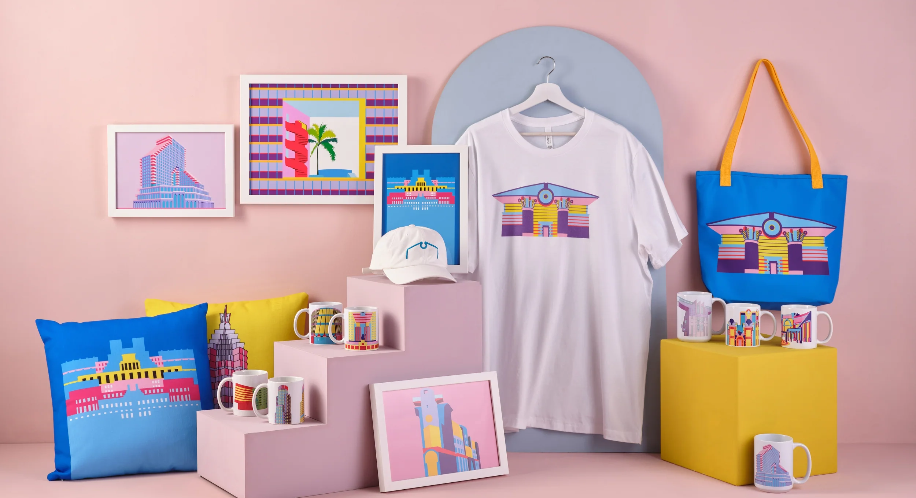
To honour the raw, cinematic power of Owen Luder's masterpiece, we have immortalised its soaring stair towers and dramatic cantilevered decks into our exclusive Trinity Square Car Park Collection.
 Featuring our bold illustrations, this curation of premium t-shirts, art posters, mugs, tote bags and more, allows you to keep the spirit of Tyneside's greatest brutalist icon alive. It is a tribute for design purists, film buffs, and anyone who appreciates architecture with a fierce, cinematic soul.
If you want to explore more radical structures from this golden age of design, you can discover our wider collection of mid-century and post-war landmarks via our Brutalist architecture collection, or browse all our UK buildings.