
Brutalist Ambition and the Elephant Building, Coventry
If you find yourself navigating the sweeping concrete rings of Coventry’s famous ring road, the city-scape offers up one of the most wonderfully eccentric, defiant architectural forms in the history of British post-war design. Striding boldly across Cox Street like a heavy-set, geometric giant, the Elephant Building -formerly the dry-sports wing of the Coventry Sports & Leisure Centre- stands as a heroic monument to heroic, creative Brutalism and postwar local civic identity.
 Completed in 1976, this striking, zinc-clad megastructure represents a brilliant, literal manifestation of heraldic storytelling. Rather than looking to the sterile, international corporate styles of the decade, the Coventry City Architects Department -led by Terence Gregory and Harry Noble- looked directly to the city’s own historic roots. They chose to build a physical, architectural version of the Coventry coat of arms, which famously features an elephant carrying a castle on its back.
 The structural execution of the Elephant Building is a masterclass in playful post-war showmanship. Designed to straddle the road on massive, load-bearing concrete pillars, the building's zinc-panelled north elevation forms the distinct, blocky "head" of the creature.
The anatomical integration is clever, and somehow both abstract and figural:
-
The Body: The vast, multi-storey main sports halls hover right over the tarmac, forming the heavy torso of the beast.
-
The Trunk: A fully enclosed, glazed pedestrian walkway dramatically stretches out from the main structure, linking it to the adjacent Grade II listed Central Baths—acting as a literal architectural trunk.
-
The Contrast: Deeply recessed geometric windows, strong planar angles, and the textured rhythm of the weathered zinc cladding give the building an incredible, ever-shifting play of light and shadow that resembles an elephant's tough hide.
 Inside, the Elephant was designed to be a bustling, high-energy cathedral of public health. Beneath its geometric shell, it housed an indoor bowls hall, multi-use sports courts with sprung floors, and squash courts. It was a space designed entirely for the people of Coventry, expanding on the legendary 1966 Olympic-size swimming pool next door to create a truly world-class, integrated public sports complex.
Sadly, despite its immense cultural and visual significance, the Elephant now finds itself in a highly precarious situation. Closed since 2020, this magnificent piece of local heritage remains unlisted, leaving it exceptionally vulnerable to the threats of decay, neglect, and potential redevelopment. For design purists, historians, and campaigners like the brilliant Twentieth Century Society, the fight to preserve and adaptively reuse the Elephant has turned it into a powerful symbol of post-war architectural preservation. It stands as a poignant reminder of a fleeting era when municipal councils possessed the sheer audacity to craft brave, memorable public buildings that refused to be quiet, timid, or generic.
Wearing the Pride of Coventry's Post-War Dream

The bold, angular geometries, graphic zinc panelling, and unmistakable zoomorphic form of the Elephant Building make it one of the most visually compelling icons of British municipal Brutalism.
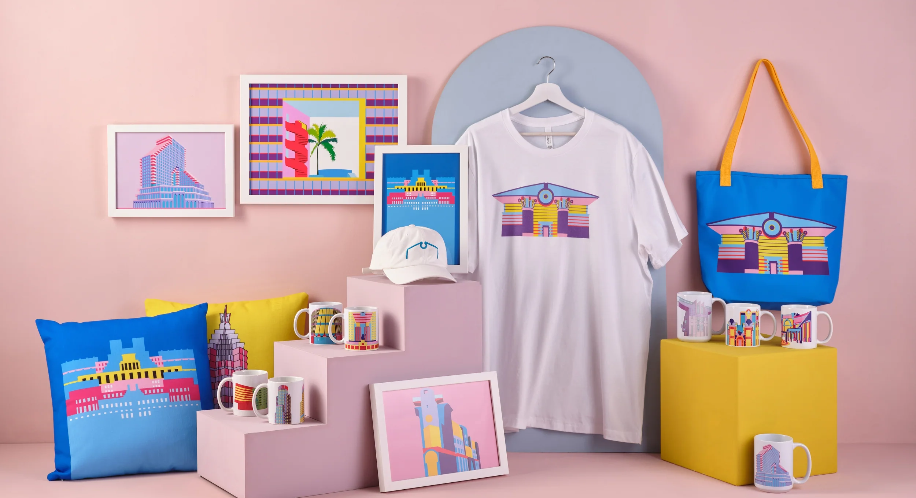
To celebrate the artistic courage and local history of this midlands legend, we have captured its radical silhouette in our brand new Elephant Building Collection.
 Featuring our signature, bold illustrations, this premium curation of art posters, t-shirts, totes, mugs and more allows design purists, post-war heritage advocates, and architecture lovers to proudly display a piece of true twentieth-century brilliance.
 If your heart beats for incredible architecture, have a browse of our Brutalist Architecture Collection, our UK Architecture collection, or hone in on our West Midlands Buildings