
Shin Takamatsu and The Dark Poetics of Architectural Machinery
Late-twentieth-century Japan was a nation hurtling at exponential speeds into a technologically fantastical, aesthetically ravishing future. Fueled by a hyper-charged cocktail of industrial innovation, financial speculation, and the unprecedented land valuations of the Bubble Era, the urban canvas of Japan became a testing ground for radical architectural experiments. Yet while the feverish boom generated a vast ecosystem of idiosyncratic design subcultures, no single body of work remains as internally coherent, fiercely dark, or psychologically intense as that of the Kyoto-based master Shin Takamatsu.
Where others responded to the urban condition with pop-art pastiche or lighthearted postmodern irony, Takamatsu produced a brooding, obsessively detailed architecture of sheer, uncompromising intent. His structures do not merely occupy city streets; they confront them. Fusing an exceptional range of historical and industrial references with newly invented structural motifs, Takamatsu created a visual language of overloaded technology crashing against subjective poetics, personal angst, and ancient ritual. His buildings are deep, psychological journeys made manifest through stone, steel, and shadow. They are machines without clear utility, temples of an unknown future, and monuments of intense personal synthesis.
At Architectural Icons, our Japanese collection celebrates this extraordinary chapter of architectural history, and other japanese architectural masterpieces besides. Here, we examine five of Takamatsu’s most iconic creations—Pharaoh, Ark, Octagon, Syntax, and Imanishi Motoakasaka—structures that embody the brooding, thrillingly fraught genius of Takamatsu at the peak of his creative power.

1. Pharaoh (Kyoto, 1984): The Minute Temple of Mechanical Menace
Positively minute in physical footprint yet staggering in its emotional impact, the Pharaoh Dental Clinic in Kyoto remains one of the most intensely expressive small buildings ever constructed. Commissioned by a dentist with a taste for the extraordinary, Pharaoh resembles less an urban clinic and more a brooding, sci-fi sarcophagus or a subterranean locomotive that has burst through the asphalt.
Takamatsu encrusted the facade with dark, polished granite and metallic elements, punctuated by prominent, eye-like circular windows and polished steel cylinders that project like engine pistons or ritualistic conduits. There is a menacing, ceremonial quality to the composition. It fuses the monumental gravitas of ancient Egyptian funerary design with the hyper-articulated precision of late-twentieth-century industrial machinery. Inside, the spaces are tightly calibrated to induce a heightened state of awareness, transforming an ordinary medical visit into an unsettling, thrilling spatial ritual.

2. Ark (Kyoto, 1983): The Locomotives of the Soul
Preceding Pharaoh by a year, the Ark Dental Clinic in Kyoto serves as a companion piece in Takamatsu’s exploration of mechanical iconography and spatial anxiety. Situated in a residential neighborhood, Ark looms over the street like an armoured, landed vessel or a stationary steam locomotive frozen in stone and steel.
The exterior is dominated by ten massive, polished steel cylinder skylights mounted atop a dark, heavily rusticated granite base, recalling the smoke stacks of nineteenth-century ocean liners or war machines. These cylindrical vents do not merely serve a functional purpose; they act as powerful iconographic markers, channeling daylight down into subterranean clinical spaces while presenting an impenetrable, inscrutable face to the city. Ark demonstrates Takamatsu’s incredible ability to transform domestic-scale institutional programs into monumental, Piranesian works of art that pull passers-by toward them with wary, fascinated awe.

3. Octagon (Kyoto, 1989): Geometric Precision and Urban Drama
As the Bubble Era reached its crescendo toward the end of the decade, Takamatsu began applying his dense, mechanical iconography to larger commercial and office structures. Octagon, built in Kyoto in 1989, stands as a masterclass in geometric rigor and dramatic textural contrast.
Organized around a powerful octagonal central motif, the building features sharp, faceted stone masses paired with bristling steel fixtures, heavy bolted joints, and deeply recessed window openings. Takamatsu treats every junction of metal and masonry with meticulous, almost obsessive attention, creating an intricate weave of industrial ornament that absorbs the eye. Octagon feels heavy, grounded, and permanent, acting as an anchor of dark structural discipline amidst the frenetic, ever-changing commercial noise of the surrounding city.

4. Syntax (Kyoto, 1988–1990): The Menacing Masterpiece
Though tragically demolished, Syntax remains perhaps the ultimate expression of Takamatsu’s total, uninhibited architectural vision. Constructed as a multi-storey retail and dining complex in Kyoto, Syntax was an explosive, complex symphony of exposed steel trusses, soaring concrete frames, and bristling metallic appendages.
Takamatsu famously described the psychological atmosphere of the building as a "space that is menacing, the parts menacing the whole, the whole menacing the parts, and even the parts menacing each other, just as the whole menaces itself." Syntax felt alive, as if it were a complex, self-generating organism or a giant Gundam-like mechanism caught mid-transformation. The circulation pathways, exposed staircases, and cantilevered platforms forced visitors to navigate a thrillingly tense labyrinth of structural steel, offering an intoxicating glimpse into an architecture that refused all notions of comfort or passive consumption.

5. Imanishi Motoakasaka (Tokyo, 1991): The Metallic Titan of Akasaka
Standing in the prestigious Akasaka district of Tokyo, Imanishi Motoakasaka represents Takamatsu's grand commercial monumentalism at its most refined and imposing. Completed just as the economic bubble began to deflate, this corporate headquarters stands as a magnificent, shining titan of polished stainless steel, dark granite, and silver-hued glass.
The facade is a tour de force of industrial craftsmanship. Massive, polished steel columns and intricate mechanical screens frame the entrance, while the upper storeys are articulated with sharp, blade-like fins and geometric cutouts that catch the shifting reflections of Tokyo’s sky. While retaining the dark, ceremonial intensity of his earlier Kyoto works, Imanishi Motoakasaka translates that energy into a soaring, sophisticated corporate icon—a gleaming monument to an era when Japanese architecture pushed structural expressionism to its absolute limits.
The Enduring Legacy of Shin Takamatsu
Shin Takamatsu’s work stands as an unrepeatable peak of late-twentieth-century architectural creativity. In an era often defined by fleeting trends and superficial spectacle, Takamatsu built with an absolute, terrifying conviction, creating spaces that challenge, thrill, and haunt those who encounter them. His buildings are not merely functional enclosures; they are fierce, personal declarations of art, engineering, and existential poetry.
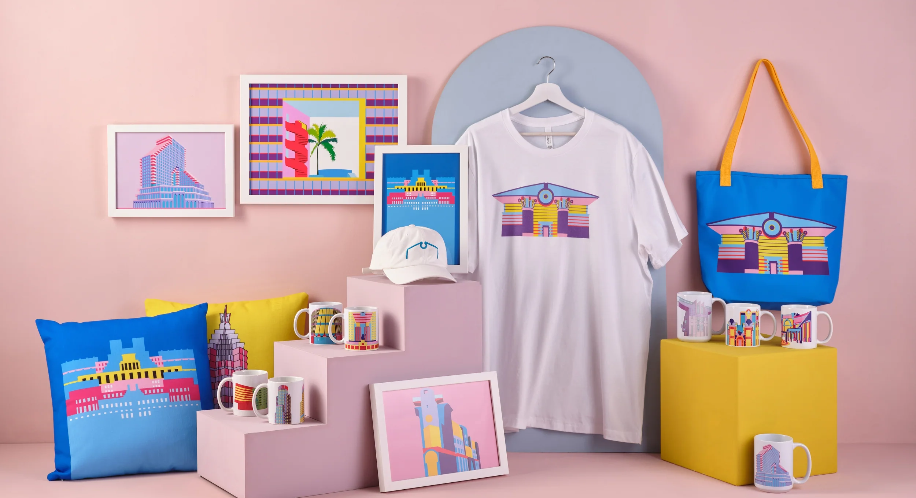
Our Shin Takamatsu Collection (Shop the collection here) pays tribute to these extraordinary monuments of Japanese postmodernism, translating their intricate geometries, mechanical textures, and dramatic profiles into posters, apparel, and home accessories—allowing you to bring a piece of this visionary architectural era into your everyday world.