
The Point, Milton Keynes, the Neon Ziggurat: Pop Culture, Sci-Fi, and 1980s Postmodernism
In the mid-1980s, anyone driving down the strictly gridded boulevards of Milton Keynes would have encountered a sight that felt less like a suburban leisure complex and more like a crashed alien spacecraft from a neon-soaked future. Rising proudly against the Buckinghamshire sky stood The Point - a glittering, mirrored glass pyramid encased in a colossal, skeletal frame of electric red steel.
 Opened in 1985, this masterwork of late-twentieth-century Postmodernism and High-Tech architecture did not just inject a heavy dose of playful architectural drama into Britain’s premier New Town. It completely revolutionised British leisure culture by introducing the UK’s very first American-style multi-screen multiplex cinema, permanently altering how a generation experienced a night out at the films.
Conceived by the Building Design Partnership (BDP), the design of The Point was a direct, joyful rejection of the monochrome austerity that dominated much of post-war British architecture. The architects looked away from heavy, brutalist concrete and instead drew deep inspiration from the high-tech, sci-fi visions of the avant-garde Archigram group, as well as the playful historicism of early Postmodern design.
The structure was a masterclass in architectural showmanship. Its core form was a stepped ziggurat of reflective glass, wrapped in an external, 70-foot structural steel truss painted a defiant, bright crimson. At night, lines of red neon running along the steel frame would burst into life, turning the building into a glowing, synthetic beacon of pure pop-culture optimism. It was designed to look fantastic from the windscreen of a car, a monument tailor-made for Milton Keynes’ unique, automobile-centric urban plan.
Step inside, and The Point was an absolute sensory overload - a literal cathedral of entertainment. Beneath its sweeping glass peak, it housed a massive, state-of-the-art social ecosystem: a buzzing social club, a massive neon-lit games arcade, restaurants, bars, and a bingo hall, all anchored by the groundbreaking ten-screen cinema operated by AMC. For the first time in Britain, going to the cinema wasn’t about visiting a fading, draughty picture house on a high street; it was a sleek, choreographed, and thoroughly futuristic event.
 The building quickly cemented itself as a legendary site of local and national folklore. In the late 1980s and early 1990s, it became the epicenter of the region's nightlife, drawing thousands of revellers every weekend who would dance beneath its glowing glass canopy. It was a physical manifestation of eighties confidence - a building that stood for fun, technology, and the democratisation of glamour.
As the decades progressed, the shifting tides of retail and entertainment trends took their toll. Newer, larger multiplexes emerged, and the glittering neon temple gradually grew quiet. Today, this magnificent postmodern icon is in grave danger. Stripped of its neon and under constant threat of redevelopment and demolition, it sits precariously on the edge of survival. Despite its cultural significance, it lacks protective listing status, making it one of the UK's most endangered and vulnerable modern landmarks.
For design historians and enthusiasts of late-twentieth-century heritage, the fight to save it has given it a mythic status. It remains a poignant, exquisitely preserved reminder of a fleeting era when British architects possessed the immense audacity to combine sci-fi geometry with commercial pop culture, creating a monument that refused to be polite, quiet, or boring.
Wearing the Spirit of Britain’s Neon Beacon
 The bold structural geometries, sharp ziggurat lines, and unforgettable red silhouette of The Point make it one of the most visually compelling icons of 80s Britain.
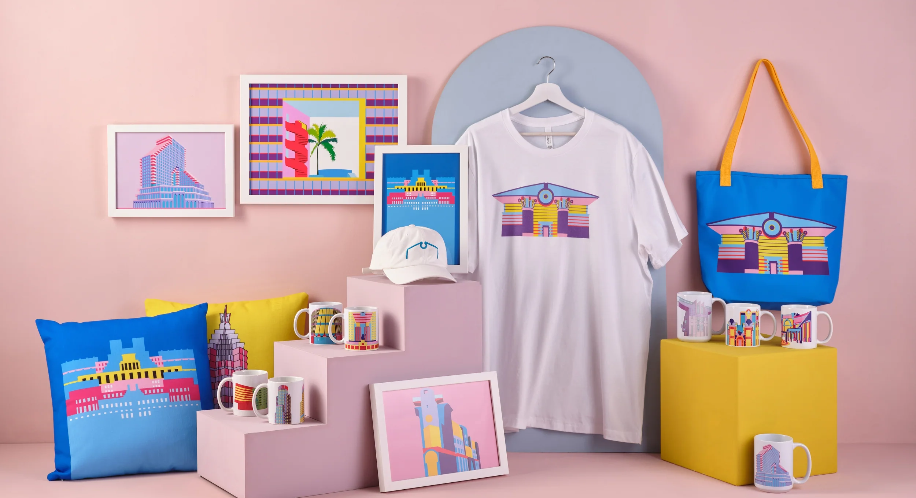
To celebrate the retro-futuristic energy of this beloved architectural legend, we have immortalised its iconic red-framed pyramid into our brand new The Point, Milton Keynes Collection.
Featuring our signature, bold illustrations, this premium curation of art posters, t-shirts, totes, mugs and more allows design purists, film buffs, and post-war heritage lovers to proudly display a piece of Britain’s boldest neon-lit dream.
If your heart beats for the radical textures, bright colours, and heroic forms of modern British design, you can also explore our wider curation of mid-century, brutalist, and postmodern landmarks across the country via our complete UK Architecture Curation.