
Cables Wynd House, The Concrete Crescent: Leith’s Legendary "Banana Flats"
To look upon Cables Wynd House is to confront post-war architectural optimism at its most heroic, uncompromising, and sculptural. Rising above the historic, fiercely independent port district of Leith in Edinburgh, this sweeping, ten-storey brutalist megastructure does not merely sit within the landscape-it commands it. Known affectionately to generations of locals as the "Banana Flats" due to its distinctive, massive crescent curve, the building stands today as a Category A-listed monument to a time when social housing was designed with grand, world-shaping ambition.

Completed in 1965 as part of a radical slum clearance scheme, Cables Wynd House was Edinburgh’s answer to the housing crises of the mid-twentieth century. The city’s planners and architects, led by the firm Alison & Hutchison & Partners, rejected the idea of building uninspired, repetitive boxes. Instead, they looked across the English Channel to the radical theories of Le Corbusier, dreaming of a modern, self-contained "city in the sky" that would elevate working-class communities out of the damp, overcrowded tenements and into the light.
The resulting structure is a masterpiece of raw architectural geometry. Its long, curved spine spans nearly 200 metres, presenting a powerful wall of rugged concrete, open-air deck access galleries, and deep, rhythmic recesses. By curving the building, the architects did not just create a striking visual landmark; they cleverly shielded the central courtyard from the fierce, biting winds whipping in off the Firth of Forth. It was an architecture born of necessity, but executed with the flair of public sculpture.

Step closer, and the ingenious mechanics of its "streets in the sky" design become clear. The building features alternating dual-aspect maisonettes and flats, accessible via wide, uncovered external walkways. These decks were explicitly designed to act as elevated pavements where neighbours could chat, children could safely play, and milk floats could originally drive right up to front doors. It was a heroic attempt to preserve the tight-knit, historic street culture of old Leith, lifting it vertically into a bright, clean, and highly structured new world.
Over the decades, Cables Wynd House absorbed the turbulent, changing cultural tides of the late twentieth century. It gained global, somewhat ominous notoriety in the 1990s when author Irvine Welsh immortalised it in his seminal novel Trainspotting as the bleak home of the character Simon "Sick Boy" Williamson. For a time, the building became a visual shorthand for post-war urban decay.
 Yet, like Leith itself, the Banana Flats possessed an undeniable grit and resilience. Architecture enthusiasts and historians began to see past the gritty pop-culture reputation, recognising the pure, unadulterated structural brilliance beneath. In 2017, Historic Environment Scotland officially recognised its national importance, awarding it a Category A listing-the highest level of architectural protection, placing this brutalist fortress on the same historic footing as Edinburgh Castle.
Today, Cables Wynd House is celebrated as a sublime icon of Scottish modernism. It stands as a poetic reminder of an era when concrete was a canvas for utopia, and when a single, sweeping gesture could redefine an urban skyline forever.
Honouring Edinburgh's Radical Modernist Icon
The powerful, sweeping geometry and raw structural rhythm of the Banana Flats make it one of the most visually compelling landmarks in post-war British architecture.
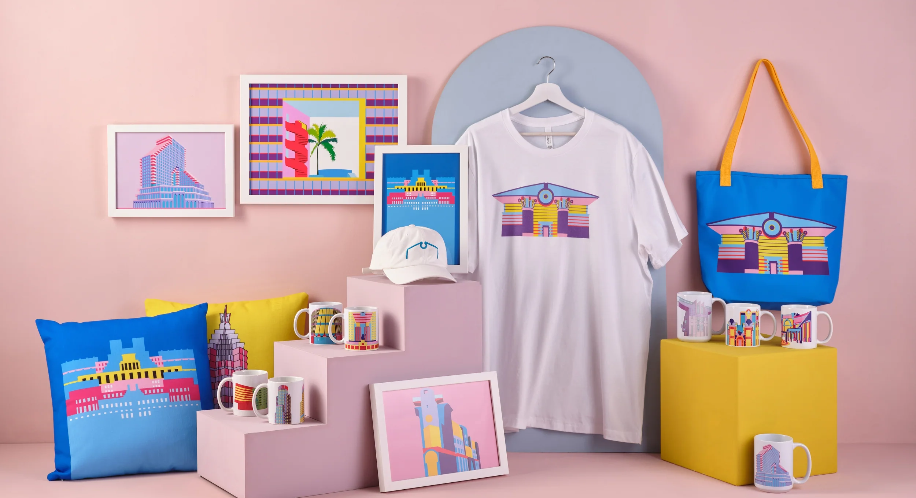
 To celebrate this monumental design, we have captured its dramatic curve, rugged concrete texturing, and iconic skyline silhouette in our brand new Cables Wynd House Collection.
Featuring our signature, highly detailed architectural illustrations, this premium curation of art posters, t-shirts, totes, mugs and more allows you to bring a piece of Leith's radical, uncompromising heritage directly into your everyday space.

If your heart beats for the bold textures and heroic scale of post-war design, you can also explore our wider curation of mid-century and brutalist masterworks across the world in our Brutalist Architecture collection, celebrate amazing social housing projects in our Masterpieces of Social Housing collection, and browse our full selection of buildings in Britain in our UK Architecture collection.